
Most businesses finish good work and move on to the next job.
The client is happy. The team knows the project went well. A few photos may live in somebody’s phone, the useful details stay in email, and the strongest proof never reaches the website.
That is a missed opportunity.
One well-documented client project can support much more than a portfolio page. It can become a case study, a sales follow-up link, a service-page proof block, a useful article, a review request, a social post, and public source material that helps search engines and AI answer tools understand what the business can actually do.
The goal is not to turn every job into a content campaign. It is to recognize the projects that contain credible evidence and capture that evidence before it disappears.
Buyers need proof that matches the decision
Generic claims are easy to write:
- responsive service
- expert team
- customized solutions
- high-quality work
- results-driven approach
They are also easy for buyers to ignore.
Specific project evidence is harder to dismiss. It can show the situation before the work, the constraint the team had to handle, the choices that were made, what was delivered, and what changed afterward.
That is useful because buyers are rarely asking only, “Can this company do the service?”
They are asking:
- Have they handled a situation like mine?
- Do they understand the risks and tradeoffs?
- Can they explain their process clearly?
- What did the client actually receive?
- Is there enough evidence to trust the next step?
A strong case study answers those questions without forcing the buyer to rely on slogans.
Start with the project, not the content format
Businesses often begin by saying, “We need a case study” or “We should post this on LinkedIn.”
Start one step earlier.
Ask what evidence the project contains.
For example:
- a clear before-and-after condition
- a difficult constraint the team solved
- a measurable improvement
- a process the buyer would value
- strong photos or visual changes
- a customer quote with useful detail
- an unusual application or industry lesson
- a combination of services that demonstrates broader capability
Once the evidence is clear, choose the formats that help buyers understand it. A visual transformation may deserve a full case study. A technical lesson may become an article. A concise outcome may work well as a service-page proof block or sales email link.
Content should follow the evidence, not the other way around.
Capture the facts while they are fresh
The best time to document a project is near completion.
That is when the team can still remember why decisions were made, what changed during delivery, and which details mattered to the client. Waiting six months usually creates a reconstruction exercise built from incomplete notes.
Use a short closeout interview to capture:
- What was happening before the project started?
- What did the client need to change?
- What constraints shaped the work?
- What did the team recommend and why?
- What was delivered?
- What changed after launch or completion?
- What can be shown publicly?
- Which facts, photos, quotes, or numbers require approval?
This does not need to become another administrative burden. A focused 20-minute conversation and a simple evidence folder can preserve most of what the marketing team needs.
Build one source packet before creating five assets
Reusing project proof works best when the facts are organized once.
Create a compact source packet with:
- approved client and project name
- short project summary
- services delivered
- audience or use case
- challenge and constraints
- approach and important decisions
- deliverables
- outcomes and approved measurements
- approved customer quote
- image files and usage permission
- links to related services
- claims that must be qualified or left out
That packet becomes the factual base for every later asset. It also reduces the risk that a social post, proposal, article, and case study tell four slightly different versions of the story.
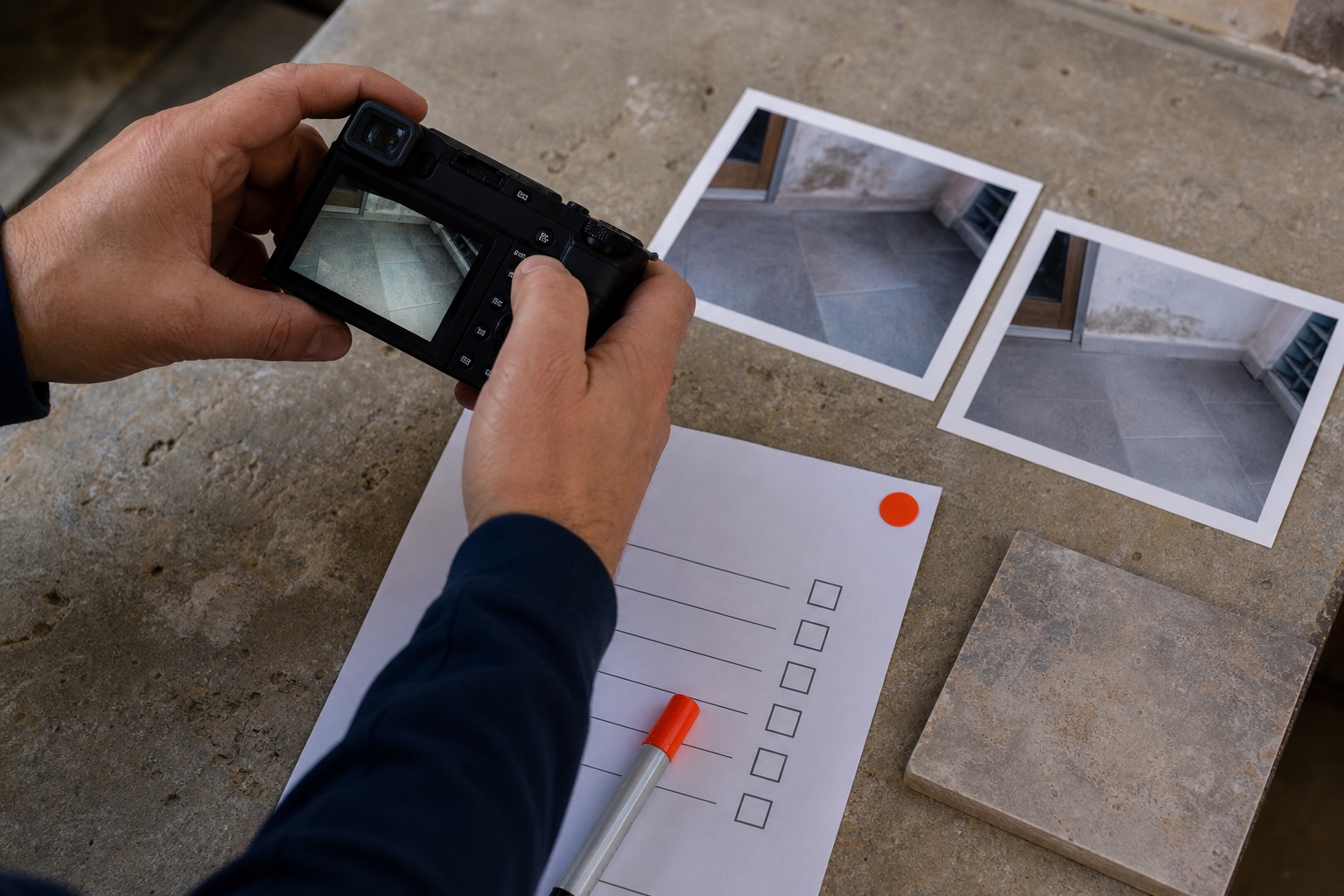
Turn the same proof into several useful assets
One project can support different stages of the buying process.
The full case study
The case study gives the complete story: situation, constraints, approach, work delivered, and outcome. It belongs in the site’s Our Work section and should make it easy for a buyer to recognize relevant experience.
Service-page proof
A shorter version can strengthen the page where buyers evaluate the related service. Two or three specific sentences and a relevant image are often more useful than another paragraph of general claims.
A sales follow-up link
Sales conversations improve when the team can send a relevant example instead of saying, “We have done something similar.” The link should match the prospect’s concern, not simply point to the newest project.
A useful article
The project may reveal a lesson that applies beyond one client. That lesson can become an educational post without exposing confidential information or turning the article into a victory lap.
Review and referral support
The closeout process is also a natural time to request a review, testimonial, or referral. Make the request specific and easy, and never write a detailed quote on the client’s behalf without approval.
Visual proof for future campaigns
Approved photos, diagrams, before-and-after views, and deliverable details can support proposals, social posts, presentations, and future service content. Organize them so the team can find them later.
Project evidence also supports search and AI visibility
Search engines and AI answer tools need public evidence to understand a business.
A service page explains what the company says it offers. A well-built case study shows what that service looks like in practice. It can connect an industry, a problem, a location, a process, and a result in a way that generic service copy cannot.
That does not mean stuffing case studies with keywords or writing them for robots. It means using clear language, accurate details, descriptive headings, useful image alt text, and natural links to the services involved.
The related article AI Search Is Turning Your Website Into a Source File explains why this public evidence matters beyond a traditional portfolio or sales deck.
An AI Visibility Audit should examine this proof layer. If AI tools can find claims but not examples, the website may not provide enough public evidence to support a confident answer.
The same gap matters in traditional SEO. Project pages can strengthen topical relevance, internal linking, and long-tail search visibility when they are specific enough to be useful.
Protect credibility while telling the story
Project content loses value when it exaggerates.
Before publishing, verify:
- the client has approved the public use of its name and logo
- outcomes are supported by records
- timeframes are accurate
- confidential details are removed
- team and partner contributions are represented fairly
- before-and-after images are genuinely comparable
- the article does not imply that every client will get the same result
If a strong number cannot be verified, use the observable change instead. Clear, measured proof is more credible than inflated language.
A practical monthly habit
At the end of each month, ask the delivery team for three candidates:
- one project with a clear business outcome
- one project with a useful process lesson
- one project with strong visual evidence
Choose the best one, build the source packet, and create the highest-value assets first. Over time, the business develops a library of proof instead of scrambling for examples whenever a proposal, service page, or campaign needs credibility.
The bottom line
Completed work should not disappear into a private folder.
The right project can help a future buyer understand the service, help a salesperson answer an objection, help a service page earn trust, and give search and AI systems clearer evidence about the business.
Start by capturing the facts. Then turn the proof into the formats buyers actually need.
MassMonopoly helps growing businesses connect websites, SEO, content, sales follow-up, and AI visibility into one practical system. If you have strong client work that is not doing enough marketing work, start with a Free Digital Health Report or ask us which projects should become case studies and source material first.