An underperforming website does not automatically need to be rebuilt.
Sometimes the right answer is a focused refresh: improve the pages, proof, calls to action, mobile experience, accessibility, and performance without replacing the foundation.
Sometimes the business has outgrown the experience, but not the platform. That calls for a strategic redesign: rethink the message, structure, content, navigation, templates, and buyer journey while keeping a workable content-management system.
And sometimes the foundation really is the constraint. The site may be trapped in a fragile page builder, overloaded with dependencies, difficult to edit, expensive to maintain, or unable to support what the business needs next. That is when a code-first rebuild or replatforming project deserves serious consideration.
The important distinction is this:
Choose the project that fixes the diagnosed problem. Do not choose a platform first and hope it fixes everything else.
The short answer
Choose a website refresh when the platform and basic structure work, but important pages need targeted improvements.
Choose a strategic redesign when the buyer experience, messaging, information architecture, content, and design need coordinated change, but the current platform can still support the business.
Choose a code-first rebuild or replatform when the technical and operating foundation—not just the appearance—is limiting performance, maintenance, editing, integrations, security, scalability, or reliable development.
A code-first site can create a lighter frontend, cleaner version control, stronger deployment discipline, and fewer plugin or theme dependencies. It does not automatically create qualified traffic, improve positioning, produce proof, or turn a weak offer into leads.
Website refresh vs. redesign vs. rebuild
| Decision factor | Focused refresh | Strategic redesign | Code-first rebuild or replatform |
|---|---|---|---|
| Best fit | The foundation works and the problems are specific | The platform works, but the buyer experience and content system need coordinated change | The platform, codebase, editing model, or dependency stack is the constraint |
| What changes | Selected pages, copy, proof, calls to action, imagery, accessibility, performance, tracking, or mobile behavior | Messaging, navigation, page structure, templates, design system, content, proof, and conversion paths | Frontend, deployment, CMS or editor, integrations, templates, data flow, and possibly the URL or content model |
| Relative investment | Lowest of the three when the scope stays focused | Moderate to high, depending on content and template scope | Highest upfront engineering and migration burden |
| SEO risk | Usually lowest because URLs and architecture can remain stable | Moderate if content, navigation, templates, or URLs change | Highest because rendering, URLs, metadata, schema, redirects, sitemaps, and tracking must all migrate correctly |
| Editing workflow | Keeps the existing editor | Usually keeps or improves the existing editor | Must be designed deliberately through a lightweight CMS, structured editor, or developer workflow |
| Maintenance | Existing stack remains, ideally with fewer problems | Existing platform remains with a cleaner system | Fewer legacy dependencies are possible, but hosting, deployment, CMS, forms, integrations, and repository ownership still require maintenance |
| Lead impact | Strong when the bottleneck is page clarity, proof, friction, speed, or broken conversion actions | Strong when the site no longer supports the real sales conversation | Indirect unless technical limitations are preventing visibility, usability, reliable iteration, or conversion |
These labels are not industry standards. One agency may call a theme replacement a redesign. Another may call the same scope a rebuild. The proposal should define what changes, what stays, who owns it, and how success will be verified.
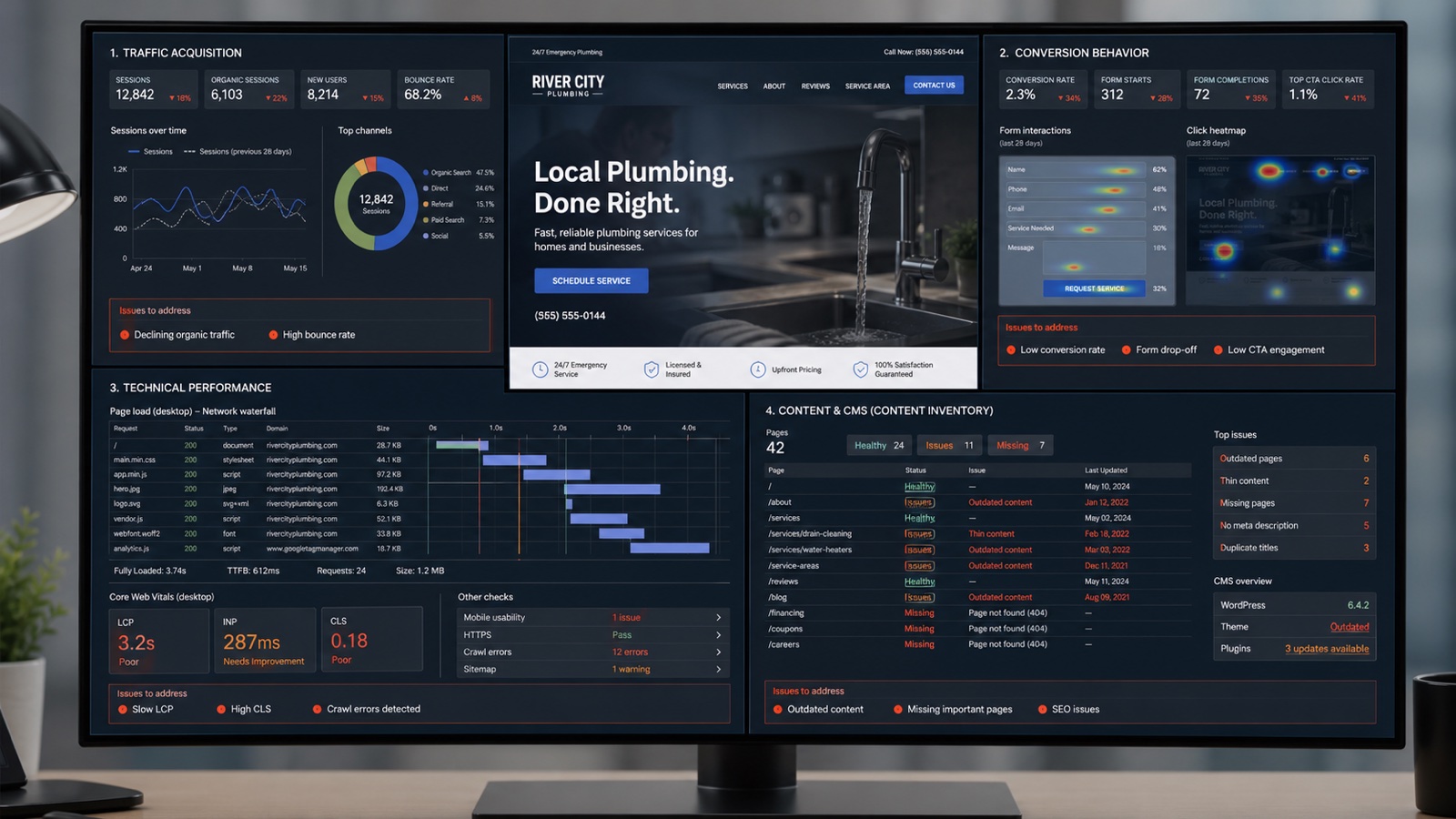
Diagnose the problem before choosing the project
The first question is not “Should we stay on WordPress?”
The first question is “What is preventing the website from doing its job?”
Separate the evidence into four categories.
1. Qualified traffic and discovery
Check:
- non-branded impressions and clicks;
- the queries and pages earning visibility;
- whether important services have pages that match buyer intent;
- local visibility, backlinks, entity signals, and relevant AI/search citations;
- paid, referral, social, email, and partner traffic;
- whether the traffic is commercially relevant.
If the site barely receives qualified visitors, a rebuild may improve the container while leaving the demand problem untouched.
2. Buyer clarity and conversion
Check:
- whether a new visitor can understand the offer quickly;
- whether the site names the right audiences and problems;
- whether proof appears near important claims;
- whether service pages answer practical buying questions;
- whether phone, form, booking, and other actions work;
- whether the next step matches the visitor’s level of intent.
If useful traffic arrives but serious buyers do not act, a focused refresh or strategic redesign may have more direct value than a new stack.
3. Technical performance and reliability
Check:
- real-user Core Web Vitals, not only one laboratory score;
- mobile behavior across full pages;
- hosting and server response;
- theme, builder, plugin, script, and font overhead;
- broken interactions, form reliability, and browser errors;
- security update burden and recurring conflicts;
- accessibility defects that affect real use.
Google’s current Core Web Vitals focus on loading performance, interactivity, and visual stability. They are useful diagnostic signals, but the platform name alone does not determine the result.
4. Content operations and ownership
Check:
- how long it takes to create or update an important page;
- whether normal edits require a developer;
- whether reusable components stay consistent;
- whether version history and rollback are reliable;
- whether staging and quality assurance exist;
- whether integrations, forms, analytics, schema, and redirects are documented;
- who owns the repository, hosting, domains, CMS, plugins, accounts, and deployment process.
A site that loads quickly but is painful to operate can still be the wrong system. A site that is easy to edit but technically fragile may also need a stronger foundation.
The broader guide to what we check before rebuilding a website covers the pre-project audit in more detail.
When a focused website refresh is the right answer
A refresh improves the existing system without replacing its core platform or architecture.
It can include:
- rewriting the homepage or highest-value service pages;
- improving proof, case studies, trust signals, and calls to action;
- repairing forms, booking links, phone actions, and lead tracking;
- simplifying navigation or a small part of the buyer journey;
- improving mobile layouts and accessibility;
- optimizing images, scripts, caching, fonts, plugins, and hosting configuration;
- cleaning up metadata, internal links, headings, schema, or indexation problems;
- creating a clearer landing page for a priority campaign or offer.
A refresh is usually the strongest choice when:
- the platform is supported and stable;
- most useful URLs and content should remain;
- the team can edit the site without constant workarounds;
- the problems are concentrated in a known set of pages or components;
- the business needs useful improvement sooner than a full redesign could deliver;
- measurement can show whether the targeted changes worked.
Do not mistake “refresh” for “make it prettier.” A serious refresh can change content, proof, page hierarchy, mobile behavior, technical performance, and conversion paths. It is simply a narrower intervention than replacing the whole experience.
MassMonopoly’s Website Refresh & Performance Tune-Up is designed for this right-sized path.
When a strategic redesign is the right answer
A redesign is appropriate when the current platform can still serve the business, but the experience built on it no longer can.
That may be true when:
- the business has changed its positioning, audiences, or primary services;
- navigation reflects the company’s internal structure instead of buyer intent;
- important pages use inconsistent templates and messages;
- the site lacks a coherent design system;
- proof is scattered or detached from the claims it supports;
- content has grown without a usable information architecture;
- the mobile experience needs coordinated change;
- the path from discovery to inquiry no longer matches the sales process.
A redesign should start with the sales and marketing problem, not a template. It normally requires:
- business and buyer discovery;
- a page and content inventory;
- search and conversion evidence;
- a proposed information architecture;
- message, proof, and page requirements;
- a reusable component and design system;
- content production and migration;
- technical, mobile, accessibility, form, analytics, and SEO quality assurance.
The article on why a website redesign should start with the sales conversation explains that planning layer.
The main redesign trap is paying for a new visual system while preserving the same vague offer, weak proof, buried services, or broken follow-up. A new look cannot carry a strategy it never received.
When a code-first rebuild or replatform is justified
A code-first rebuild replaces more of the foundation. The frontend may be rebuilt with a static or server-rendered framework, connected to a lightweight CMS, and managed through a repository with preview deployments, automated testing, and controlled releases.
That approach can be valuable when the evidence shows:
- the current builder or theme creates recurring technical debt;
- plugin and script dependencies repeatedly cause conflicts, security work, or performance regressions;
- reliable version control, previews, testing, and rollback are difficult;
- the site requires reusable components or integrations that the current system handles poorly;
- the editing experience is too fragile or too unstructured for the content team;
- performance remains constrained after the high-impact repair work is complete;
- the business needs application-like functionality that does not fit a conventional marketing-site stack;
- the organization has a realistic owner for the CMS, repository, deployment, hosting, forms, integrations, and maintenance.
For a content-led marketing site, a lightweight static-first framework such as Astro with a practical CMS can be a stronger fit than a large application framework. That is an architecture hypothesis, not a universal rule. The right choice depends on publishing needs, integrations, personalization, developer capacity, and long-term ownership.
A code-first rebuild is probably the wrong immediate move when:
- the site receives very little qualified traffic;
- the offer and positioning are still unclear;
- the strongest pages have not been identified;
- lead tracking is unreliable;
- the current stack has not received a disciplined performance and dependency audit;
- the team has no plan for non-technical content editing;
- the decision is driven by one red performance score or general frustration;
- the organization is not prepared to own the new deployment and content workflow.
The WordPress performance optimization guide shows the repair order to test before blaming the CMS for every speed problem.
WordPress versus a coded site is an operating-model decision
WordPress can be fast, stable, and maintainable when the theme, builder, plugins, hosting, media, scripts, and editorial process are disciplined.
A custom-coded site can also become slow or fragile when it ships excessive JavaScript, depends on a complicated build process, has no usable editor, or requires a developer for every routine change.
Compare the operating model, not the logos:
- Who can publish and update content?
- How are previews, approvals, and rollback handled?
- Who owns the code and deployment accounts?
- What happens when a form or integration changes?
- How are redirects, metadata, schema, analytics, and consent handled?
- How quickly can a campaign page be created?
- Can the system be maintained by more than one specialist?
- What is the fallback if the original developer disappears?
The fastest frontend is not automatically the most useful business website. The best system is the one that delivers a strong buyer experience and can be operated reliably.
Compare total cost of ownership, not only the proposal price
There is no universal price or timeline for any of these paths. Page count, content, design, integrations, data, accessibility, migration, QA, and approval complexity determine the real scope.
Evaluate:
- discovery and strategy;
- copy and content migration;
- design and component production;
- development and integration;
- accessibility and browser QA;
- search-preservation work;
- analytics and conversion tracking;
- hosting, licenses, security, and backups;
- ongoing updates and support;
- internal time required to publish;
- dependence on a specific vendor or developer;
- the cost of adding the next service, campaign, or feature.
A refresh usually has the lowest upfront burden, but years of repeated patches can become expensive if the foundation is genuinely broken.
A redesign can be the best middle path when the platform works but the experience does not.
A code-first rebuild has the highest migration and engineering burden, but it may reduce future friction when the current stack repeatedly blocks reliable work.
The honest comparison is not “cheap WordPress” versus “fast custom code.” It is the full cost of building, operating, changing, and protecting the system over time.
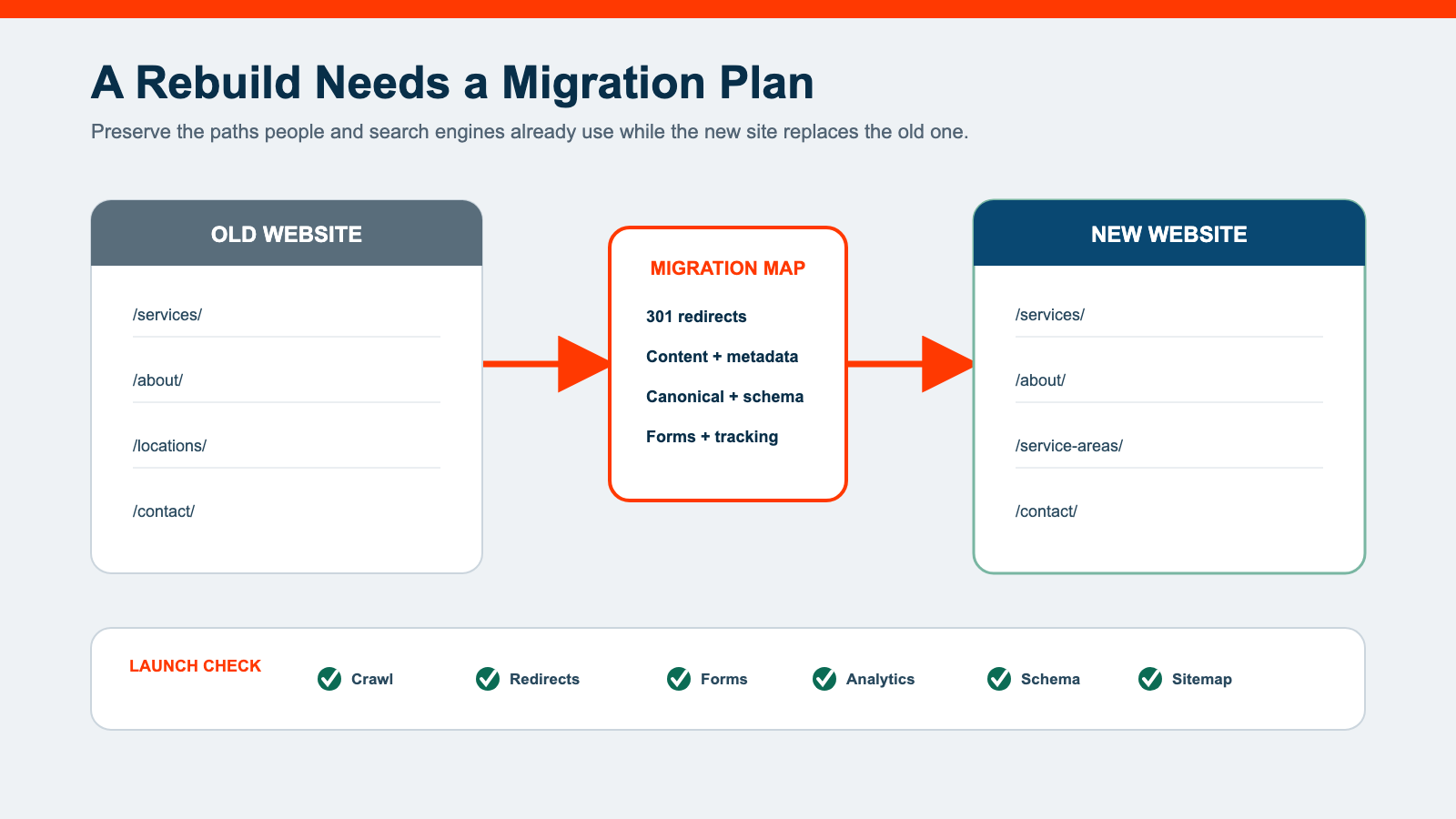
A rebuild needs a migration plan, not just a launch date
Replatforming changes more than the visible design.
Google’s site-move guidance recommends preparing and testing the new site, mapping old URLs to their new destinations, implementing redirects, and monitoring both the old and new versions. Google also advises changing one major variable at a time when practical and warns that rankings can fluctuate temporarily while pages are recrawled and reindexed.
Before launch, the migration plan should account for:
- every indexable URL and its keep, improve, merge, redirect, or retire decision;
- title tags, descriptions, headings, canonicals, structured data, and social metadata;
- images, downloads, alt text, and linked assets;
- internal links and navigation;
- XML sitemaps and robots directives;
- server-side 301 or 308 redirects for permanently moved URLs;
- forms, calendars, CRM routing, email notifications, and thank-you paths;
- analytics, consent, ad pixels, key events, and source attribution;
- accessibility, responsive behavior, browser testing, and performance;
- Search Console verification and post-launch monitoring;
- a rollback and incident-response plan.
Preserving URLs where they still make sense is usually safer than changing them to make the new sitemap look tidy. When a URL must change, redirect it to the closest relevant replacement rather than sending everything to the homepage.
Official references:
Which path is most likely to improve leads?
That depends on the bottleneck.
If qualified traffic is missing
Prioritize search intent, service-page coverage, local visibility, authority, relevant content, paid acquisition where appropriate, partnerships, referrals, and distribution. A rebuild may support those systems, but it does not replace them.
If traffic exists but buyers do not act
Prioritize message clarity, proof, service-page depth, calls to action, mobile usability, form reliability, and buyer friction. This often supports a refresh or strategic redesign.
If the site is slow, unstable, or difficult to maintain
Run the technical and operating audit. Repair the highest-impact bottlenecks first. Rebuild only if the remaining constraint is structural.
If inquiries arrive but disappear afterward
Fix routing, notifications, CRM capture, response time, follow-up, and measurement. Rebuilding the website without fixing the handoff leaves the response gap intact.
MassMonopoly’s Websites That Convert guide connects website decisions to the broader buyer and follow-up system.
A practical decision scorecard
Choose a focused refresh when most of these are true
- The platform and editor are stable.
- The useful URL structure should remain.
- The business offer is mostly clear.
- The problems are concentrated in a known set of pages.
- Performance issues have identifiable fixes.
- The team needs improvement quickly.
- Success can be tied to specific page or conversion metrics.
Choose a strategic redesign when most of these are true
- The platform can stay, but the experience cannot.
- The business, audience, or service mix has changed.
- Navigation and information architecture no longer fit.
- Messaging, proof, templates, and conversion paths need coordinated work.
- The content team can still operate the current CMS.
- A full code migration would add risk without solving a proven constraint.
Choose a code-first rebuild when most of these are true
- Technical or page-builder debt is recurring and verified.
- Editing, testing, rollback, and deployment are unreliable.
- The site needs a different content or component model.
- Performance remains constrained after disciplined optimization.
- Important integrations or functionality do not fit the current stack.
- The organization has a credible CMS, hosting, repository, deployment, and maintenance owner.
- The migration can preserve search equity, tracking, forms, and business continuity.
If several answers are unknown, the next purchase should be a diagnosis—not a rebuild.
Frequently asked questions
Is a custom-coded website faster than WordPress?
It can be. A static-first site with disciplined assets and limited JavaScript can have an excellent performance ceiling. A poorly built coded site can still be slow, and a disciplined WordPress site can perform well. Compare measured field performance, dependency weight, editing needs, and maintenance—not the platform label.
Will rebuilding a website hurt SEO?
It can create temporary fluctuations and permanent losses if URLs, content, metadata, internal links, redirects, rendering, or crawl controls are mishandled. A careful migration can preserve valuable URLs and route changed pages correctly, but it should never be treated as risk-free.
How often should a business rebuild its website?
There is no reliable calendar rule. Review the site regularly, but rebuild only when business needs, buyer behavior, content operations, technical condition, or platform limitations justify it. Age by itself is not a diagnosis.
Can we keep WordPress and still improve performance?
Often, yes. Hosting, caching, images, fonts, scripts, plugins, database work, page-builder output, third-party tags, and layout behavior can all affect performance. Diagnose those layers before replacing the CMS.
What about headless WordPress?
Headless WordPress can preserve a familiar editorial backend while using a separate frontend. It also adds APIs, preview complexity, deployment infrastructure, and more places for integrations to fail. It can be useful when the editorial and engineering requirements justify that overhead; it is not automatically the best compromise.
What should we measure before deciding?
Measure qualified traffic, query and landing-page performance, real-user Core Web Vitals, conversion actions, form reliability, mobile usability, editing time, recurring technical incidents, plugin or dependency burden, support cost, and the speed of launching important content or campaigns.
The bottom line
Use a refresh when the foundation works and the problems are specific.
Use a redesign when the platform works but the buyer experience and content system need coordinated change.
Use a code-first rebuild when the technical and operating foundation is the proven constraint.
The goal is not to defend WordPress or chase a newer stack. The goal is to choose the smallest responsible intervention that improves clarity, trust, performance, search preservation, conversion, and the team’s ability to operate the website.
If you are unsure which path fits, MassMonopoly can review the current site, identify the real bottleneck, and scope the right-sized next move—from a focused Website Refresh & Performance Tune-Up to a strategic Web Design & Development project.