The titles sound interchangeable: fractional CMO, marketing consultant, outsourced marketing department, agency, and on-demand marketing team.
They are not interchangeable.
A growing business can hire an experienced fractional marketing leader and still have nobody to build the landing page, write the campaign, clean the CRM, launch the ads, or report what happened. It can also hire a capable production team and still lack the senior leadership to decide which market, offer, message, and channel deserves attention.
The right choice depends on the ownership gap inside the business—not the title on a proposal.
The short answer
A fractional CMO is usually the better fit when the primary need is senior marketing leadership: company-level strategy, positioning, priorities, budget direction, team leadership, executive alignment, and accountability for the marketing function.
An on-demand marketing team is usually the better fit when the business needs coordinated strategy and execution across several disciplines without hiring a full internal department. The work may include websites, content, search, advertising, creative, CRM, automation, reporting, and campaign operations.
An internal marketing hire is usually the better fit when the company has enough stable work for a dedicated role, can define the role clearly, can manage the person well, and understands which specialist support will still be required.
Some businesses need a fractional CMO and an execution team together. The important question is who owns the decision, who owns the work, and who is accountable when the two do not connect.
What a fractional CMO should own
A fractional chief marketing officer serves as a part-time senior marketing executive. Exact scopes vary, but useful fractional CMO work often includes:
- translating business goals into marketing priorities
- clarifying market position, audience, offer, and message
- deciding where the budget should and should not go
- building the plan and operating cadence
- selecting and managing internal staff, agencies, and vendors
- aligning marketing with sales, operations, and leadership
- defining meaningful measurements and reviewing performance
- identifying capability gaps and sequencing hires or partners
- explaining marketing decisions at the leadership level
The value is not a stack of ideas. It is senior judgment applied to the company’s real constraints.
A fractional CMO should be able to say no to a distracting channel, connect a campaign to capacity and revenue goals, resolve competing requests, and make the responsibilities clear. If the engagement only delivers a deck and disappears, the business did not receive ongoing executive ownership.
MassMonopoly’s fractional CMO service is designed for that leadership gap.
What a fractional CMO may not own
Do not assume “CMO” means a complete production department.
Depending on the engagement, a fractional leader may direct the work but not personally:
- design and develop the website
- produce weekly content
- manage every ad campaign
- configure CRM fields and automations
- edit video or photography
- build reports and fix tracking
- execute email and text campaigns
- perform daily search optimization
- coordinate every revision and asset
That boundary is not a flaw when it is explicit. Senior leaders should not need to be the sole copywriter, designer, developer, paid-media specialist, and CRM administrator.
The problem begins when the company expects execution, the fractional CMO expects an existing team, and nobody budgets for the people who will turn the decisions into finished work.
Before hiring, ask: What work is included, what work is directed, and what work must be supplied by someone else?
What an on-demand marketing team should own
An on-demand marketing team gives the business access to several disciplines through one coordinated operating relationship. The strongest model does not merely take tickets. It helps prioritize the work, completes it, connects the systems, and uses the results to shape the next cycle.
Depending on the need, the team may own:
- campaign planning and production
- website strategy, design, development, and maintenance
- search and AI-visibility work
- content strategy, copy, design, and publishing
- paid-media setup and management
- CRM organization, forms, pipelines, and automation
- email and text campaign operations
- analytics, reporting, and conversion diagnosis
- creative coordination across channels
- project management, QA, and launch follow-through
The commercial value is coordinated capacity. Instead of asking one internal generalist to cover every specialty or managing a loose collection of freelancers, the business has a defined team, priorities, handoffs, and delivery rhythm.
That does not remove the need for client participation. Leadership still owns business truth, access, approvals, compliance, capacity decisions, and the sales feedback that tells marketing whether a lead was useful.
MassMonopoly’s on-demand marketing team combines senior direction with the execution needed to move approved priorities into market.

What an on-demand team should not become
An on-demand model is not a limitless queue of unrelated requests. If every stakeholder can insert urgent work, priorities change daily, and nobody approves decisions, flexible capacity turns into fragmented output.
A useful engagement needs:
- one accountable client-side decision-maker
- defined business goals and current priorities
- a visible backlog and sequencing rule
- access to the required systems and subject-matter experts
- realistic review and approval windows
- agreed measures of progress and performance
- clear boundaries around legal, technical, and operational decisions
It should also preserve senior thinking. A team that only waits for instructions may produce deliverables while leaving the company to solve the hardest strategy questions alone.
Where an internal marketing hire fits
An internal hire offers context, proximity, and day-to-day focus. The person can participate in meetings, learn the product deeply, work across departments, and respond to fast operational needs.
The challenge is role design. A job description that asks one person to own brand strategy, graphic design, web development, search, video, paid media, CRM administration, email, analytics, and sales enablement is not one coherent job. It is a department compressed into a vacancy.
An internal hire is a strong fit when:
- the business can define the most important ongoing responsibilities
- there is enough consistent work for the role
- a capable manager can set priorities and develop the person
- the company can accept that outside specialists will still be needed
- access to internal knowledge and daily coordination is especially valuable
The guide to on-demand marketing services versus hiring explores the staffing tradeoff in more depth.
Five questions that reveal the real gap
1. Do you have strategy but no execution?
The plan may already be sound. Leadership knows the target market, message, offer, and next campaign, but the work stalls because nobody has the time or specialist capability to build it.
That points toward an execution team or a clearly scoped specialist—not another strategy engagement.
2. Do you have execution but no prioritization?
Designers, writers, developers, and media partners may all be busy while leadership cannot explain which work matters most or how it connects to growth.
That points toward fractional leadership, stronger internal leadership, or an on-demand team that explicitly includes senior strategy.
3. Do you need daily embedded ownership?
If marketing must participate in daily product, sales, operations, and executive decisions, an internal leader or operator may be necessary. A fractional leader can still help, but the engagement must provide enough presence and authority for the decision speed required.
4. Is the work narrow or cross-functional?
One defined need—such as paid search management, a website rebuild, or a research project—may call for one strong specialist or project team.
A connected need—such as a campaign that requires positioning, landing pages, creative, ads, CRM routing, follow-up, and reporting—benefits from coordinated cross-functional ownership.
5. Who will supply the decisions and feedback?
Outside support cannot invent product truth, operational capacity, customer objections, approval authority, or sales outcomes. Identify who will answer questions, approve work, provide access, and report what happened after a lead entered the business.
If nobody owns that interface, every model will struggle.
A practical monthly operating rhythm
The names of the meetings matter less than the sequence. A useful month usually moves through four connected phases.
Decide
Review business priorities, capacity, sales feedback, current performance, customer questions, and the backlog. Choose the few outcomes that deserve focus. Define the audience, offer, message, channel, owner, approval path, and measure before production expands.
Build
Create the required assets and systems: copy, design, landing pages, content, campaigns, tracking, CRM fields, automations, sales materials, or reporting. Coordinate dependencies so one missing form or approval does not strand the rest of the campaign.
Launch
Complete preflight QA, confirm budgets and destinations, verify tracking and handoffs, publish or activate the approved work, and watch the real customer experience. Make sure the person or team receiving inquiries knows what is coming.
Measure and adjust
Review what reached the market, how people responded, whether leads were qualified, where handoffs slowed down, and what should change. Feed those findings into the next decision cycle.
This is the operational difference between “we have marketing help” and “the marketing function moves.”
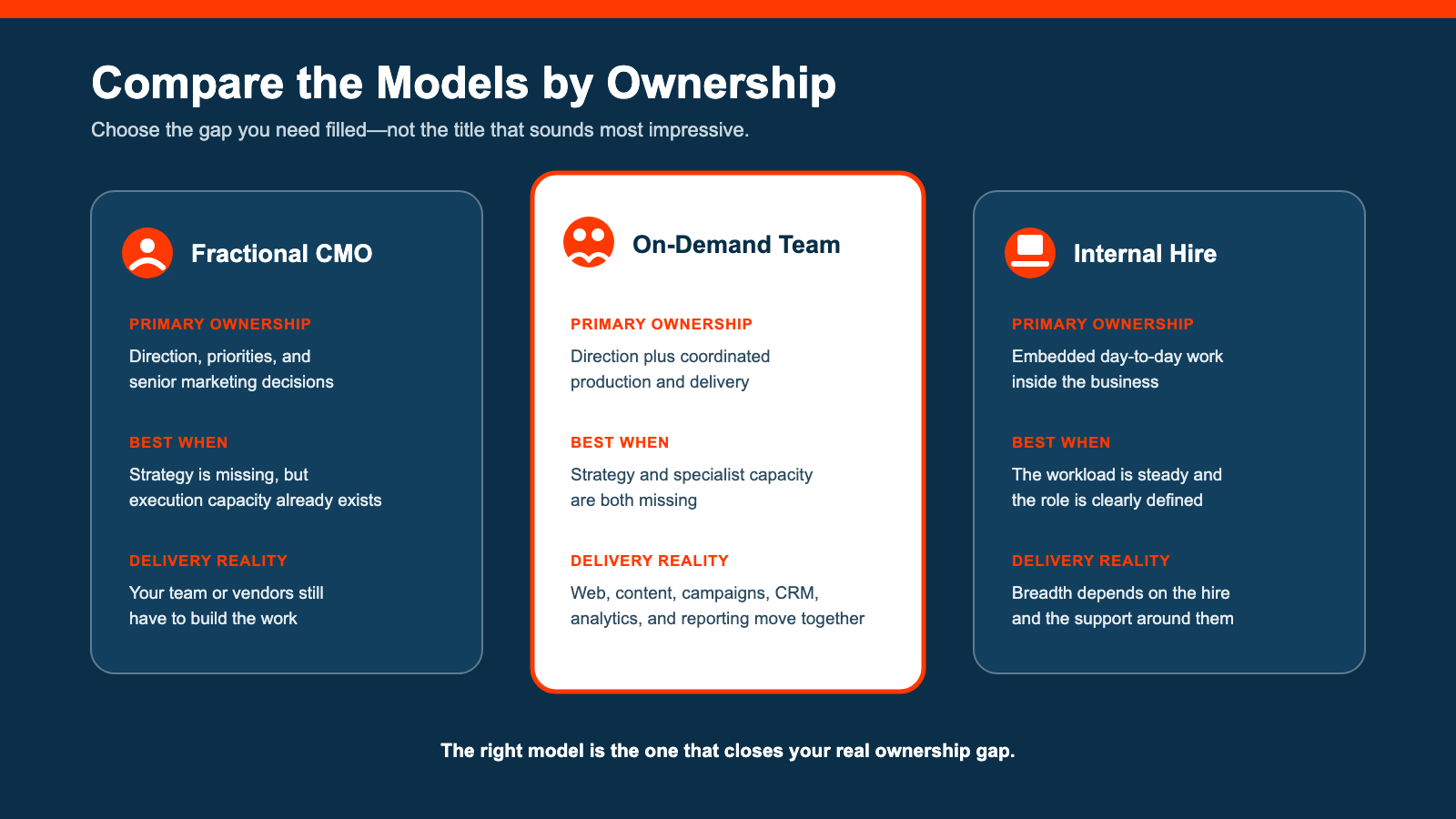
Compare the models by ownership
Choose a fractional CMO when:
- the company needs senior marketing leadership at the executive table
- positioning, priorities, budget, or team design are unclear
- several vendors or internal contributors need direction
- leadership needs a marketing operating plan and accountability
- the primary constraint is decision quality rather than production capacity
Choose an on-demand marketing team when:
- approved priorities repeatedly stall before launch
- the work requires several specialties that must stay coordinated
- managing separate freelancers and vendors consumes too much internal time
- the company needs both strategic guidance and completed execution
- marketing systems, campaigns, content, and reporting need ongoing care
Choose an internal hire when:
- the responsibilities are stable enough to define as a real role
- daily company context and cross-department participation are essential
- there is sufficient work and management support
- leadership understands which outside capabilities remain necessary
Use a combined model when:
- a fractional CMO must lead internal staff and an external execution team
- an internal marketing leader needs specialist capacity without expanding every role
- the on-demand team can execute while a senior fractional leader owns company-level decisions
The comparison of agency, in-house, and on-demand marketing provides another view of these operating structures.
Compare total management load, not just the monthly fee
A credible comparison includes more than the proposal amount.
For an internal hire, consider recruiting time, compensation, benefits, onboarding, management, tools, training, coverage, and the outside specialists the role cannot replace.
For a collection of freelancers or agencies, consider procurement, separate briefs, overlapping retainers, revision management, access control, inconsistent reporting, and the internal time needed to make the pieces work together.
For a fractional CMO, include the execution resources required to implement the plan.
For an on-demand team, examine how capacity is allocated, which skills are actually available, who prioritizes requests, what is excluded, and whether senior leadership is part of the model.
The right question is not “Which option looks cheapest?” It is “Which option gives us the ownership and capability we need at a level the business can support?”
Common bad fits and warning signs
A fractional CMO with no authority
Senior advice will not change the business if nobody follows the priorities, shares the data, or allows the leader to manage contributors.
An execution team with no decision-maker
Production slows when every deliverable has several reviewers and no final owner. The client-side approval path is part of the operating system.
A generalist role expected to replace a department
One talented person can own meaningful work. They cannot be simultaneously senior executive, developer, designer, media buyer, writer, CRM architect, analyst, and project manager at a professional level and sustainable pace.
A vendor paid for activity without business feedback
Impressions, clicks, tasks, and published assets do not reveal whether the sales team reached the lead, whether the opportunity fit, or why the deal was lost. The business must close that loop.
An unlimited-scope promise
Capacity is always finite. Ask how priorities are chosen, how concurrent work is handled, what turnaround depends on, and what happens when a request requires a capability outside the agreement.
Three example situations
The founder is still the marketing department
The founder approves every message, chooses every channel, writes half the briefs, and chases several vendors. The business may need a fractional CMO or a senior on-demand model to take over prioritization and coordination. If execution is also missing, leadership alone will not remove the bottleneck.
The company has a marketing manager but not a full team
The manager understands the business and owns the calendar but lacks development, design, search, media, or automation capacity. An on-demand team can extend that internal owner without pretending the manager should perform every specialty.
The company has agencies but no unified direction
The website partner, advertising agency, and content writer each report activity, but campaigns do not share a message or measurement system. A fractional CMO can align the portfolio. A coordinated on-demand team may also consolidate execution if fragmentation is the deeper problem.
Growing businesses can also use a simpler marketing operating approach to reduce scattered activity before adding more capacity.
Questions to ask any marketing partner
- Which decisions will you own, and which remain with our leadership?
- Which deliverables will your team complete directly?
- Which skills are consistently available, and which require another vendor?
- Who sets priorities when several stakeholders request work?
- How will marketing connect with sales and operational capacity?
- What access, information, and approval speed do you need from us?
- How will you report completed work, business signals, and unresolved blockers?
- What happens when the plan changes mid-month?
- How are files, accounts, data, and documentation handled?
- What will we own and be able to continue if the engagement ends?
Clear answers are more valuable than an impressive title.
The bottom line
Choose a fractional CMO when the business primarily needs senior marketing leadership, company-level priorities, team direction, and executive accountability.
Choose an on-demand marketing team when the business needs coordinated strategic and execution capacity across several marketing disciplines.
Choose an internal hire when the role is clear, the workload is durable, daily context matters, and the company can manage the person and supplement specialist gaps.
Combine the models when leadership and execution are both missing—but define the handoff so strategy does not become a document and execution does not become a pile of disconnected tasks.
MassMonopoly can help identify the missing layer and build a practical engagement around fractional leadership, an on-demand team, or both. The goal is not to sell the biggest structure. It is to give the business clear ownership and get the right work done.