Short answer: a website discovery process is the planning work that happens before design. It settles what the site needs to do for the business, who it is for, what the current site already earns in search and leads, and which pages, proof and features the new site needs. Done well, it ends with a sitemap, a page-by-page plan and a scope you can price, so design starts from decisions instead of opinions.
Most website projects that go sideways don’t fail in design or development. They fail earlier, when nobody wrote down what the site is supposed to accomplish, which buyers it serves, or which existing pages are quietly bringing in search traffic. Discovery is where those questions get answered. Here is how we run it at MassMonopoly, what it should produce, and how to tell when a project has skipped it.
Why discovery comes before design
- Changes are cheap on paper and expensive in code. Moving a page in a sitemap takes minutes. Moving it after design and development takes days.
- Redesigns can lose search traffic. If nobody inventories the pages that rank, a launch can drop URLs Google has been sending visitors to for years. Discovery finds those pages and plans the redirects.
- Stakeholders disagree quietly. Sales wants one thing, leadership another, and the site ends up designed around whoever spoke last. Discovery puts the goals in writing before anyone looks at mockups.
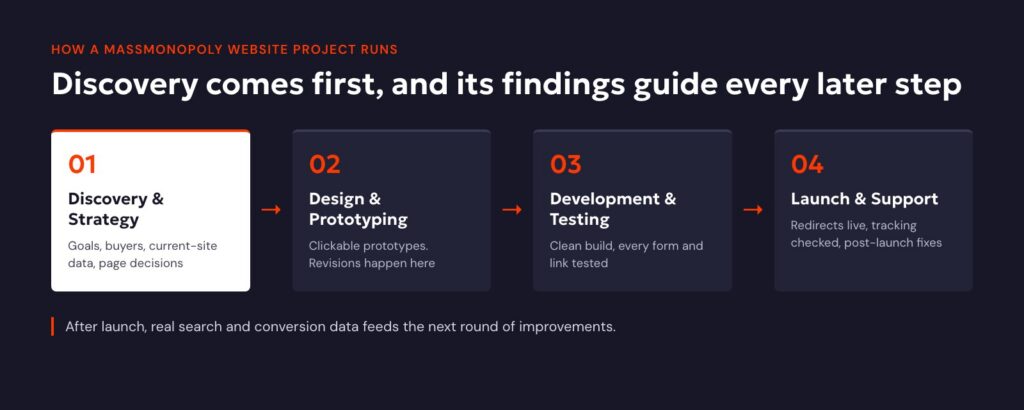
The website discovery process, step by step
1. Start with the sales conversation
We begin with how the business actually wins work: who buys, what they ask on first calls, which objections slow deals down, and which services deserve a bigger share of the pipeline. A website should continue the sales conversation, not start a different one. We go deeper on this in why a redesign should start with the sales conversation.
2. Define goals you can measure
“A modern look” isn’t a goal. “More qualified quote requests for the industrial division” is. We agree on the few outcomes that matter, such as form submissions, booked calls, quote requests or purchases, and on how each one will be tracked in analytics and the CRM after launch.
3. Audit what the current site already earns
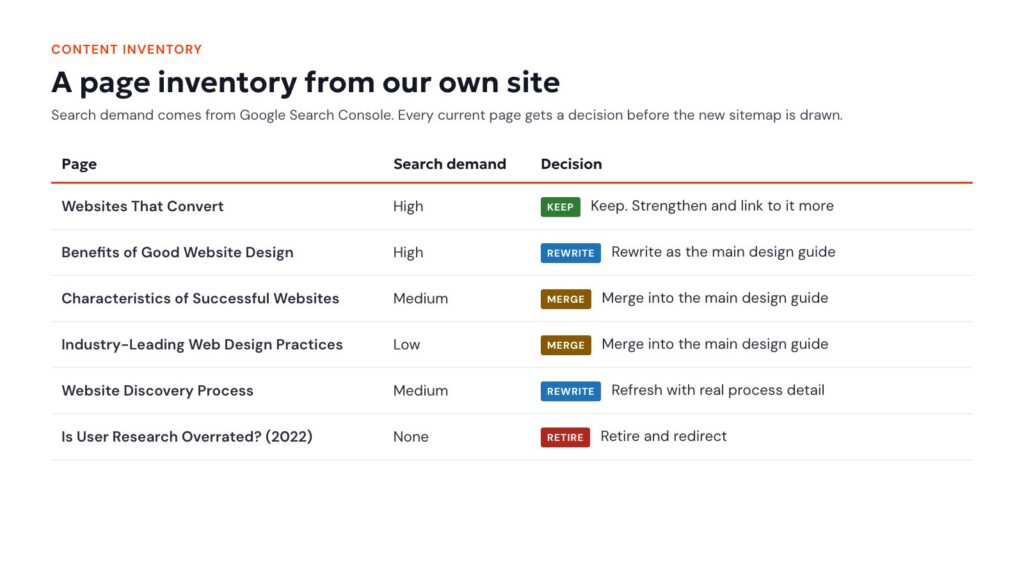
Before anything is torn down, we look at Google Search Console and analytics: which pages earn impressions and clicks, which searches bring buyers in, which pages turn visits into inquiries, and which get nothing. Some pages that look dated are doing real work in search. Others look fine and do nothing at all.
4. Inventory content and proof
Every current page gets a decision: keep, rewrite, merge or retire. We also collect the proof buyers look for, including case studies, certifications, client logos, reviews and photos of real work. Missing proof is one of the most common reasons a good-looking site doesn’t convert.
5. Map buyer questions to pages
Each important buyer question needs one clear home. We build a keyword-to-page map so that service pages, industry pages and supporting articles each have a single job, instead of three pages competing for the same search.
6. Review competitors and search results
We look at who shows up for the searches that matter, what their pages cover and where they are thin. The point isn’t to copy them. It’s to learn what buyers expect to see and where you can be clearer or more credible.
7. List technical and integration requirements
Forms, CRM connections, booking tools, ecommerce, gated content, accessibility needs, hosting and analytics events all shape the build, so they need to be known before the project is priced.
8. Turn it into a plan
Discovery ends with decisions on paper: the sitemap, page priorities, a redirect plan for every URL that changes, content and proof assignments, and a scope with deliverables, price and timing.
What a discovery phase should produce
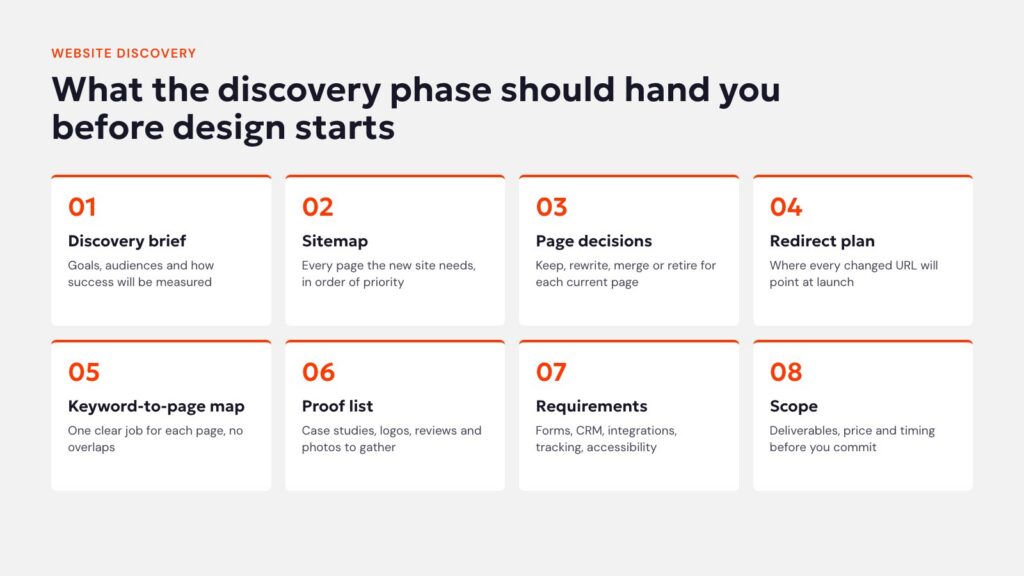
If discovery is finished, you should be able to hold these in your hands before design starts:
- A short discovery brief covering goals, audiences and how success will be measured
- A sitemap with page priorities
- A keep, rewrite, merge or retire decision for every current page
- A redirect plan for every changed URL
- A keyword-to-page map
- A proof list: what already exists and what still needs to be gathered
- Technical and integration requirements
- A scope with deliverables, price and timing
Questions to answer before design starts
- Who are the two or three buyer types the site has to serve?
- What does each of them need to see before they contact you?
- Which services or products deserve the most attention?
- Which current pages bring in search traffic or leads today?
- What proof do you have, and what is missing?
- What should happen after someone submits a form?
- Who approves content, and how quickly?
How long does discovery take?
It depends on the size of the site and how many people need to weigh in. A focused site with one audience can be planned in a few working sessions. A multi-division site with hundreds of pages, integrations and several approvers takes longer. We scope the project after a first conversation, and the proposal sets out what discovery covers and how long it will take before you commit.
Signs a project skipped discovery
- The new sitemap was copied from the old site or from a template.
- Nobody can say which pages bring in leads today.
- Content is “to be provided later” for most pages.
- Redirects weren’t planned before launch.
- Success is defined as launching on time.
If several of these sound familiar, the project may not need a bigger budget. It may need a pause to plan. Our guide to choosing between a refresh, a redesign and a rebuild can help you decide how much change the site actually needs.
Discovery doesn’t stop at launch
Launch replaces assumptions with real visitor behavior. In the first months we review search and conversion data and adjust pages based on what buyers actually do. Here is what a 90-day website improvement plan after launch can include. For the design side of the same decisions, see why good website design matters for business and our guide to websites that convert.
Planning a new website?
Our web design and development projects start with discovery, so design decisions are grounded in your goals, your buyers and what your current site already earns.