“AI marketing consultant” can describe very different things.
One provider may help a leadership team choose where AI belongs in the marketing operation. Another may configure tools and workflows. A software company may use the same title for a product that analyzes campaign data and recommends changes. A general marketing consultant may add AI to an existing strategy engagement without owning implementation.
The title does not tell you what will be delivered.
Before hiring anyone, define the business problem, the operating change you expect, and what the consultant will leave behind. Useful AI marketing consulting should produce more than a tool list, a prompt library, or a presentation about what might be possible.
The short answer
An AI marketing consultant helps a business decide where AI can improve marketing performance, how the new workflow should operate, which tools and data sources are appropriate, what still requires human judgment, and how results will be measured.
The work may include research, search and AI visibility, content operations, campaign analysis, reporting, lead follow-up, customer segmentation, workflow automation, or team training. The strongest engagements move from diagnosis to a controlled implementation and documented handoff.
If the work stops at brainstorming use cases, the business still has to solve the hard part. If it jumps directly into automation, the team may scale a weak process faster.
MassMonopoly’s AI marketing consulting starts with the marketing system and business outcome, then uses the right mix of AI systems, automation tools, data sources, and human review for that layer.
An AI marketing consultant is not automatically an AI tool
This distinction matters because the market uses the same language for people, services, and software.
A consultant
A consultant should understand the business context, diagnose the workflow, recommend a path, define controls, and help the team adopt the change. Depending on the scope, that person or team may also implement and manage the system.
A software platform
A platform may aggregate data, find patterns, generate content, recommend campaign changes, or automate part of a workflow. It can be useful, but it cannot decide whether the underlying process fits the business, whether the data is trustworthy, or whether the recommendation is appropriate without context and oversight.
A general marketing partner using AI
A marketing team may use AI inside research, content, search, reporting, and operations without selling a separate AI transformation project. For many growing businesses, this is the practical path: improve work that already matters instead of building an isolated AI program.
The right choice depends on whether the gap is judgment, implementation, capacity, software, or ongoing ownership.
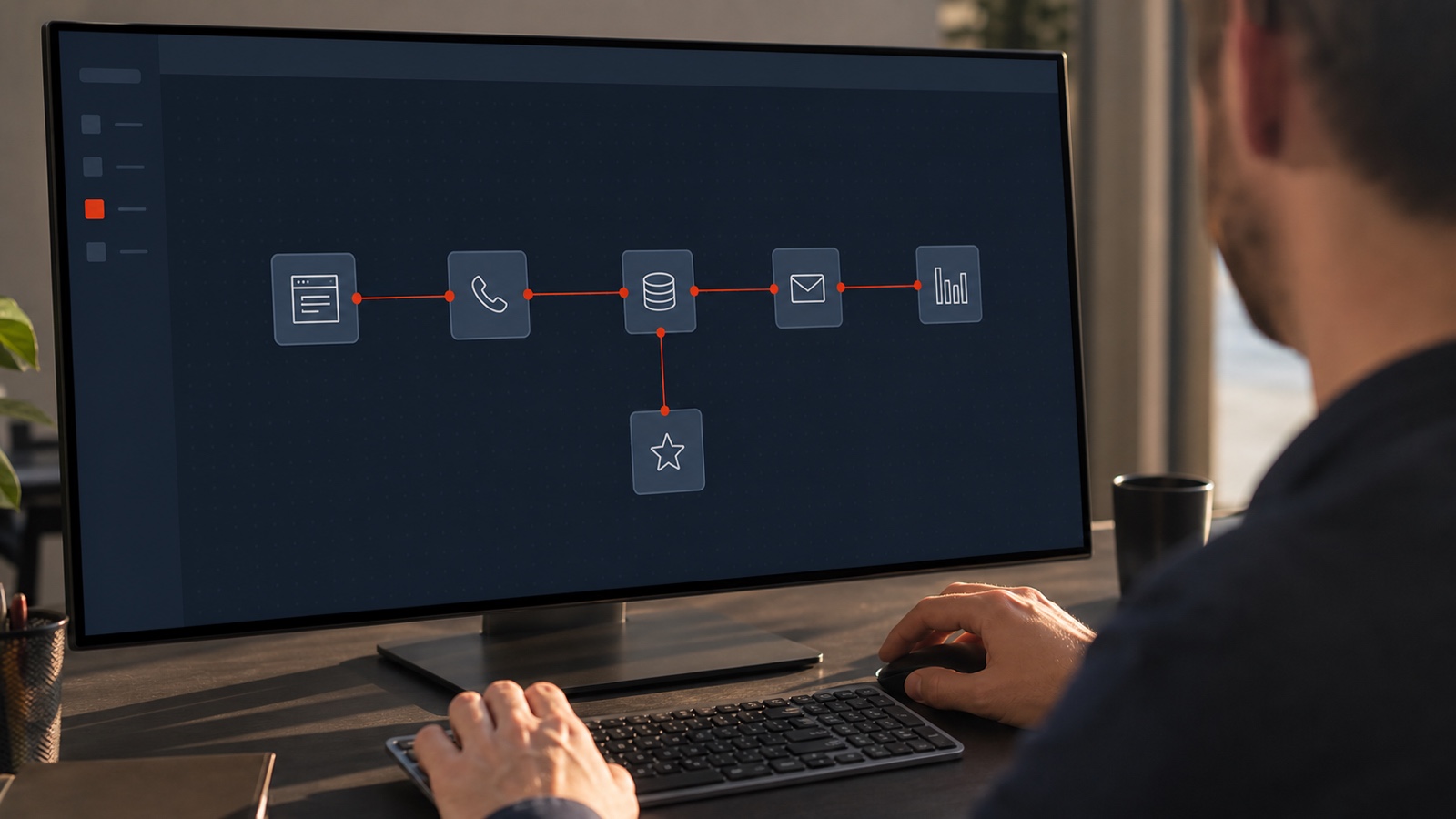
What useful AI marketing consulting work looks like
A credible engagement should follow a sequence. The details will vary, but skipping the early decisions usually creates expensive cleanup later.
1. Define the business problem and baseline
“Use more AI” is not a useful objective.
A better starting point sounds like this:
- qualified inquiries are not followed up consistently
- the team spends two days every month assembling reports
- subject-matter experts cannot keep up with content demand
- search visibility is shifting, but the company does not know where it appears in AI answers
- campaign data lives in separate systems and nobody trusts the summary
- customer questions repeat, but the website and follow-up do not answer them clearly
The consultant should document the current process, the people involved, the source systems, the failure points, and the baseline measure. Without that, there is no honest way to say whether the change helped.
2. Map the workflow before choosing tools
Good automation starts with handoffs, decisions, and exceptions.
For a lead-response workflow, the map might cover the form or call, contact record, notification, first response, assignment, follow-up sequence, booked appointment, sales outcome, and reporting. For a content workflow, it might cover source interviews, research, outline, drafting, factual review, brand review, optimization, publishing, distribution, updates, and performance feedback.
The tool should fit that operating map. The map should not be distorted to justify whichever platform the consultant already sells.
3. Prioritize use cases by impact, effort, and risk
Not every possible automation deserves to be built.
A useful prioritization considers:
- business impact if the workflow improves
- frequency of the task
- quality and availability of the data
- reversibility if the output is wrong
- privacy, compliance, and brand risk
- human time required to review exceptions
- implementation and maintenance cost
- whether the team will actually use the result
The best first use case is often narrow enough to control and meaningful enough to prove value.
4. Design the output, controls, and decision rights
The consultant should specify what the system can do, what it cannot do, when a human must approve, and who owns the final decision.
For example, an AI-supported content process may assist with research, clustering, first drafts, and consistency checks while a human remains responsible for source accuracy, positioning, client facts, claims, tone, final editing, and publication. A reporting system may surface anomalies and draft a summary while a strategist verifies the data and explains the business meaning.
Clear decision rights protect quality and make the system easier to operate.

Human review is part of the system
Human review should not be treated as an embarrassing temporary step that disappears once the automation is “smart enough.” In marketing, context changes constantly. Offers, prices, customer objections, brand standards, compliance requirements, and business capacity can change faster than a reusable workflow.
Review is especially important when the work affects:
- public claims, statistics, or comparisons
- client, patient, employee, or customer data
- pricing, scope, legal language, or regulated topics
- published content and brand voice
- ad budgets and campaign activation
- outbound messages or replies to real people
- lead qualification, routing, or suppression
- recommendations based on incomplete attribution
The goal is not to force a human to reread every low-risk output forever. The goal is to design the right review depth for the risk and to keep a clear path for exceptions.
5. Build a controlled pilot
A pilot should test the real operating path, not a polished demo with perfect inputs.
That means using representative data, normal handoffs, actual review standards, and the people who will own the workflow. It should include failure cases: missing information, conflicting instructions, low-confidence output, a system outage, and a request that should be escalated rather than automated.
For search and AI visibility, a controlled pilot might audit a defined query set, improve a small group of source pages, document the changes, and recheck visibility over a clean window. For content operations, it might move one article from source interview through publishing and measure both time saved and revision quality. For lead follow-up, it might verify the complete path from inquiry to contact record, notification, response, booking, and outcome reporting.
The article AI Visibility Starts With the Pages You Already Have explains why improving public source material is often a better first move than chasing a new AI platform.
6. Measure business and operating results
Time saved matters, but it is not the only measure.
Depending on the use case, useful measures may include:
- hours removed from repeat reporting or production work
- fewer manual handoff errors
- faster response time
- higher completion or follow-up rate
- better content revision quality
- more qualified search visibility
- clicks into a service or offer page
- booked conversations or qualified opportunities
- user adoption and exception volume
- cost to maintain the workflow
A consultant should separate a clean technical run from a business result. Generating 100 summaries is not a success if nobody trusts or uses them. Sending faster follow-up is not enough if the handoff creates confused prospects. Publishing more content is not useful if it attracts the wrong audience and never supports a buying decision.
7. Document ownership and the handoff
The business should know what it owns when the engagement changes or ends.
The handoff should cover:
- system purpose and scope
- source data and access requirements
- prompts, rules, templates, and workflow logic
- approval and escalation gates
- owners and backups
- known limitations
- monitoring and maintenance schedule
- cost and vendor dependencies
- change log and rollback path
- training for the people who will operate it
If the consultant remains involved, the ongoing ownership model should still be explicit. Someone must review performance, update source truth, handle failures, and decide when the workflow no longer fits.
Five practical areas where AI consulting can help marketing
Search and AI visibility
AI can accelerate query research, content-gap analysis, entity mapping, answer extraction, competitor review, and monitoring. The work still depends on accurate pages, clear proof, technical access, and a strategy that connects visibility to a relevant offer. An AI Visibility Audit can identify where the public source layer is strong, weak, or missing.
Content operations
AI can help organize interviews, summarize source material, build briefs, draft variations, repurpose approved material, and run consistency checks. It should not invent customer proof, client facts, citations, or subject-matter expertise. The process in turning one client project into search, sales, and AI visibility proof shows why the source packet matters more than fast generation.
Reporting and analysis
AI can surface anomalies, combine observations across platforms, and draft a first-pass explanation. A strategist still needs to verify comparable periods, attribution limits, data quality, and what the numbers mean for the business.
Lead capture and follow-up
AI and automation can help classify inquiries, summarize context, route tasks, and support timely follow-up. The workflow needs clear identity, consent, suppression, human-response, and escalation rules. A managed system such as Growth Hub can provide the CRM and automation layer, but the operating design remains the important part.
Campaign planning and QA
AI can compare drafts against approved facts, find missing assets, check message consistency, and identify likely implementation gaps. Budget decisions, market judgment, claims, activation, and live customer interaction still require accountable owners.
Seven questions to ask before hiring an AI marketing consultant
1. What business result are we improving first?
Look for a specific operating or commercial outcome. Be cautious if the answer begins and ends with “AI adoption,” “innovation,” or a long list of tools.
2. What will you review before recommending a solution?
The consultant should ask about goals, people, workflows, data, access, customer journey, sales feedback, current tools, privacy, brand rules, and measurement. A recommendation made before the process is understood is usually a product pitch.
3. What will you deliver and implement?
Clarify whether the scope includes an audit, roadmap, configuration, integrations, prompts, templates, training, pilot, documentation, ongoing operation, or some combination. Ask which work is completed directly and which work becomes your team’s responsibility.
4. Where does human review remain mandatory?
The consultant should be able to name the risk levels, approval gates, exception path, and accountable owner. “The AI checks itself” is not a control.
5. How will data, access, and permissions be handled?
Ask which systems will be connected, what data will be processed, where it will be stored, which vendors receive it, what permissions are required, and how access is removed. Give the workflow only the access it needs.
6. How will we know whether it worked?
Require a baseline, a small set of measures, a review window, and a distinction between technical output, adoption, operating improvement, and business impact.
7. What will we own when the engagement ends?
Confirm ownership of accounts, data, documentation, prompts, templates, automations, source files, analytics, and the knowledge required to maintain or replace the system.
Common warning signs
- the proposal starts with a platform instead of a business problem
- every use case is described as low risk and fully automatable
- the provider cannot explain the human-review model
- speed or volume is presented as the business result
- custom software is recommended before existing tools and workflows are assessed
- data access and vendor dependencies are vague
- the implementation has no named owner after launch
- the consultant promises guaranteed ROI or predictive accuracy without a credible baseline
- the team cannot show how recommendations connect to finished marketing work
What a practical first 90 days can look like
Days 1–15: diagnose
Choose one business problem. Map the current workflow, source systems, owners, risk, and baseline. Identify existing tools before adding another subscription.
Days 16–30: design
Define the future workflow, inputs, outputs, review gates, access, measures, and failure path. Decide what will be automated, assisted, or kept fully human.
Days 31–60: pilot
Build the narrow workflow with representative inputs. Test normal cases, exceptions, handoffs, and rollback. Train the people who will use and review it.
Days 61–90: stabilize
Measure adoption, quality, time, exceptions, cost, and business signals. Fix the operating gaps, document the system, and decide whether to expand, hold, or stop.
That is enough time to learn something real without pretending the entire marketing operation should be transformed at once.
The bottom line
An AI marketing consultant should help you make a better operating decision, not simply expose you to more tools.
Start with one meaningful problem. Map the work. Define the human judgment that must remain. Test the real path. Measure whether the team and the business improved. Then expand only when the first workflow is useful, controlled, and owned.
MassMonopoly helps growing businesses apply AI inside search visibility, content, reporting, automation, and marketing execution without turning the engagement into an open-ended technology project. If you want to identify the best first use case, start a conversation.