Short answer: HomeAdvisor and Angi are no longer meaningfully separate choices for contractors. They are part of the same Angi platform family, and the real decision is whether paying for platform-supplied opportunities fits your margins, response capacity, and long-term growth plan.
This 2026 comparison looks at what contractors should verify before signing up: how the platforms relate to each other, where the true cost shows up, what Angi’s current credit rules do and do not cover, and when an owned lead-generation system is the better investment.
Angi vs. HomeAdvisor: Are They Still Different?
For contractors comparing HomeAdvisor vs. Angi, the first fact to understand is ownership. HomeAdvisor combined with Angie’s List under the business that became Angi Inc. The contractor lead product is now presented through Angi and Angi Leads, while HomeAdvisor remains visible in legacy URLs, policy pages, and older account references.
That means this is not a clean side-by-side comparison between two independent lead companies. In practice, contractors should compare the specific Angi offer placed in front of them against other ways of generating work, including Google Local Services Ads, local SEO, referrals, repeat customers, and their own website.
| Question | What contractors need to know |
|---|---|
| Are they separate companies? | No. HomeAdvisor is part of the same Angi platform family, not an independent alternative. |
| Is pricing fixed? | No universal public rate applies to every contractor. Pricing and account terms can vary by trade, market, demand, and product. Get the exact offer in writing. |
| Is every opportunity a guaranteed job? | No. Angi’s own help content says it cannot guarantee that a particular lead will result in a job. |
| Can every poor-fit lead be refunded? | No. Current policy limits eligibility and generally issues account credit rather than cash refunds. |
What Does Angi Cost Contractors in 2026?
There is no honest universal cost-per-lead number. The number a contractor sees can depend on the trade, project category, market, service radius, demand, account configuration, and whether the opportunity comes through a subscription, lead flow, advertising product, or another Angi program.
Before signing, ask for a written breakdown of:
- Membership, subscription, or advertising fees
- How lead or opportunity charges are calculated
- Whether opportunities are exclusive or may reach other contractors
- Minimum spend, lead-flow settings, and pause controls
- Contract length, renewal language, and cancellation terms
- Credit eligibility, request deadlines, and how credits are applied
Use Cost per Booked Job, Not Cost per Lead
A lead price can look affordable while the booked-job cost is not. Contractors need to include every paid opportunity, unreachable prospect, estimate, follow-up hour, and lost quote in the calculation.
Use this simple formula:
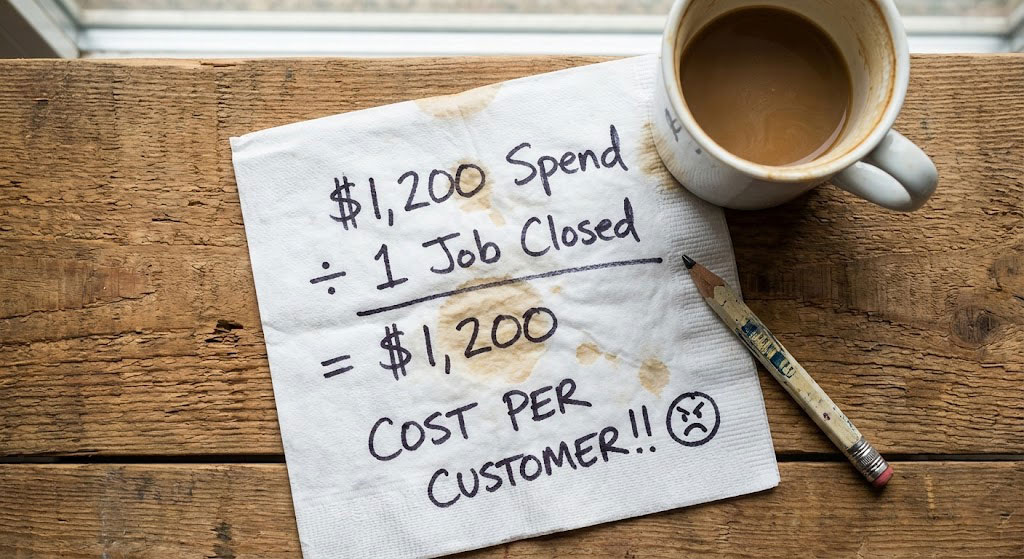
Total platform spend ÷ booked jobs = acquisition cost per booked job
Example: if a contractor spends $1,200 on a program and books two jobs, the platform acquisition cost is $600 per booked job before counting sales time, estimates, travel, and office follow-up. If only one job closes, it is $1,200. Those are examples, not a claim about Angi’s typical results.
Compare that cost with the gross profit on the work, not the top-line project price. A $12,000 project can still be a poor acquisition if materials, labor, callbacks, commissions, and overhead leave too little margin after the marketing cost.
Contractors evaluating several channels should also read our breakdown of Google Local Services Ads, Google Maps, and website investment. The channels work differently, so the same lead-price target should not be applied to all of them.
The Lead-Credit Rules Matter More Than the Sales Pitch
Angi’s current published credit guidance is specific. It says eligible credits are issued at Angi’s discretion, must generally be requested within 30 days, are applied as store credit toward future charges, and expire after six months.
The policy lists examples that may qualify, including a duplicate request, incorrect contact information, a location outside the contractor’s profile, a mismatched job type, or a competitor testing the system. It also lists common situations that are already accounted for in pricing and are not normally eligible: the customer does not call back, already hired someone, changed their mind, is shopping, or simply did not choose the contractor.
Angi’s help center also says credits are not offered for leads obtained through an annual subscription or Opportunities selected by the contractor. Read the current lead-credit guidelines and the Angi credit-request instructions before agreeing to a plan. Save a copy of the terms attached to the specific offer you receive.
When Angi Leads May Make Sense
Platform leads can be useful as a controlled supplemental channel when a contractor:
- Has open production capacity and needs opportunities quickly
- Answers calls and texts immediately during the hours leads arrive
- Tracks each opportunity through contact, estimate, booked job, revenue, and gross profit
- Can cap spending and stop a category that does not produce profitable work
- Treats the platform as a test, not the only source of demand
The biggest mistake is judging the channel from one good job or one bad week. Set a test budget, define the minimum number of opportunities needed for a fair sample, and decide in advance what acquisition cost and gross-profit return will count as a pass.
When an Owned Lead System Is the Better Move
Contractors should put more money into assets they control when they have a stable service area, real project proof, a reliable team, and enough runway to build local visibility. That means a fast website, strong service pages, Google Business Profile activity, reviews, local search coverage, clear calls to action, call tracking, and consistent follow-up.

The advantage is not that every website lead is automatically better. The advantage is control. Your business owns the pages, proof, tracking, first-party contacts, review process, and follow-up data. Improvements can compound instead of disappearing when a monthly lead budget stops.
If your website already gets traffic but produces few calls or forms, start with the contractor missed-revenue calculator and our guide to why contractor websites fail to generate leads. The problem may be conversion, proof, speed, mobile usability, or follow-up rather than a lack of traffic.
A Practical 30-Day Test
- Document the offer. Save the fee schedule, lead categories, service area, credit rules, cancellation terms, and any minimum commitment.
- Set a hard budget. Use an amount the business can evaluate without needing one lucky project to rescue the test.
- Measure the full path. Record received, contacted, qualified, estimated, won, lost, revenue, gross profit, and reason lost.
- Protect response time. Assign a real person or a reliable follow-up system to respond while the opportunity is still active.
- Compare channels fairly. Put Angi beside referrals, repeat work, Local Services Ads, Google Maps, organic search, and website leads using cost per booked job and gross profit.
The Verdict: Angi vs. HomeAdvisor in 2026
For contractors, Angi vs. HomeAdvisor is mostly the wrong comparison. They are part of the same platform family. The better question is whether the specific offer can produce profitable booked work after lead costs, follow-up time, estimates, credits, and lost opportunities are counted.
Use platform leads as a measured supplement if the economics work. Do not let them replace the assets and customer relationships your company can own.
MassMonopoly’s Contractor Marketing system connects website conversion, local SEO, reviews, content, lead capture, and follow-up for contractors that want a more durable source of booked-work opportunities. Review the program and compare its economics with what you currently spend to rent leads.