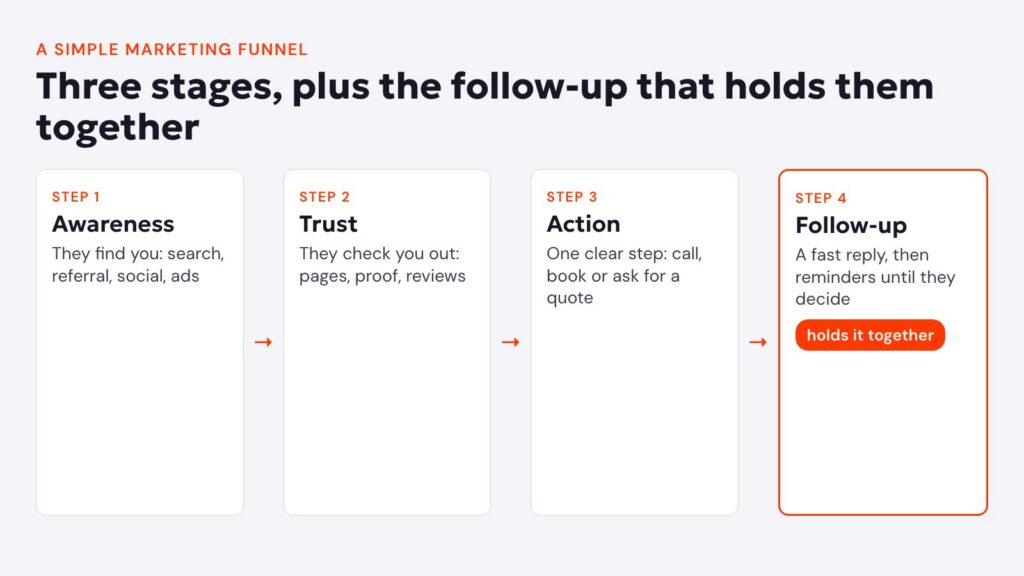
Short answer: a simple marketing funnel has three stages. People find you (awareness), check you out (trust) and take one clear step (action). Fast follow-up holds the stages together. Most growing businesses don’t need a ten-step automated funnel. They need these three stages working, with nothing confusing in between.
A lot of growing businesses struggle with funnels. Some overcomplicate them with tools and automations nobody maintains. Others skip structure altogether and hope people find their own way. Here’s a simple marketing funnel that works, what each stage needs and how it looks for different kinds of business.
Stage 1: Awareness
This is where people first come across you: a Google search, your Google Business Profile, a referral, a social post, an ad or an event. The goal isn’t to sell. It’s to be noticed by the right people for the right reasons.
- Show up where your buyers already look, not everywhere. For a local service business that’s usually Google Maps and search. For a B2B company it might be search, LinkedIn and industry events.
- Lead with a clear message: who you help, what you offer and why it matters.
- Publish useful content that answers the questions buyers ask before they’re ready to talk to anyone.
Don’t lead with discounts. Lead with clarity.
Stage 2: Trust
Once someone knows you exist, they do a quick gut check. Is this company legitimate? Have they solved this problem before? Will they be easy to work with? This is where growing businesses can stand out without a big budget.
- Show proof: reviews, case studies, photos of real work, client logos and certifications.
- Answer objections before they’re asked: pricing ranges, timelines, process and FAQs.
- Stay in touch with people who aren’t ready yet, through email, helpful content or remarketing.
If someone isn’t ready to buy, your job is to stay useful until they are.
Stage 3: Action
This is where attention turns into revenue. The job here isn’t to push harder. It’s to remove friction.
- Use one clear call to action per page, such as call, book or request a quote.
- Keep forms short and make sure they work on a phone.
- Say what happens next: “We’ll reply within one business day with two times to talk.”
If your site is vague, slow or full of options, people will leave. Our list of signs your website is costing you customers is a good place to check.
The part most funnels miss: follow-up
Plenty of funnels work right up to the moment someone gets in touch, and then the inquiry sits in an inbox. Fast follow-up is what turns an inquiry into a customer:
- An instant confirmation when someone fills in a form.
- A missed-call text back when nobody can answer the phone.
- Reminders for quotes and proposals that haven’t had a reply.
- A review request once the work is done, which feeds the trust stage for the next customer.
This is where a CRM earns its keep. In Growth Hub, the platform we set up for clients, form replies, missed-call texts, pipeline reminders and review requests run automatically.
What a simple funnel looks like in practice
The three stages are the same for every business. What changes is where people find you, what makes them trust you and the step they take.
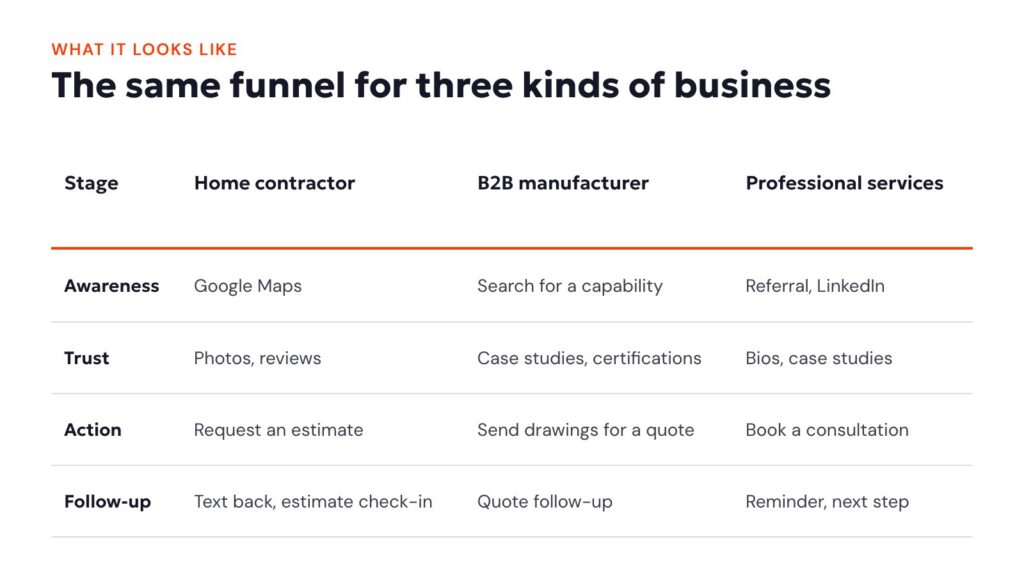
- A home contractor: found on Google Maps, trusted because of project photos and reviews, and contacted with a call or an estimate request. Follow-up is a text back and an estimate check-in.
- A B2B manufacturer: found when an engineer searches for a capability, trusted because of case studies and certifications, and contacted with a quote request and drawings. Follow-up is a quick engineer reply and a quote follow-up.
- A professional services firm: found through referrals and search, trusted because of bios, case studies and a clear process, and contacted with a consultation booking. Follow-up is a confirmation, a reminder and a clear next step.
How to build yours this month
- Week 1: write down your three stages: where people find you, what proves you’re credible and the one action you want them to take.
- Week 2: fix the action stage first: one clear call to action per page, a working mobile form and a confirmation message.
- Week 3: add proof to your key pages: reviews, a case study and answers to common questions.
- Week 4: set up follow-up: instant replies, reminders for open quotes and review requests.
Then measure how many people move from each stage to the next. If one step loses far more people than the others, that’s your marketing bottleneck, and it’s the next thing to fix.
Need help putting it in place?
Our on-demand marketing team builds and runs funnels like this for growing businesses: the pages, the proof, the follow-up and the reporting, on a monthly plan.